Venture · live
Manufacturing
Additive manufacturing: one part, a production run, or a whole product line.
Visit manufacturing.opusaether.com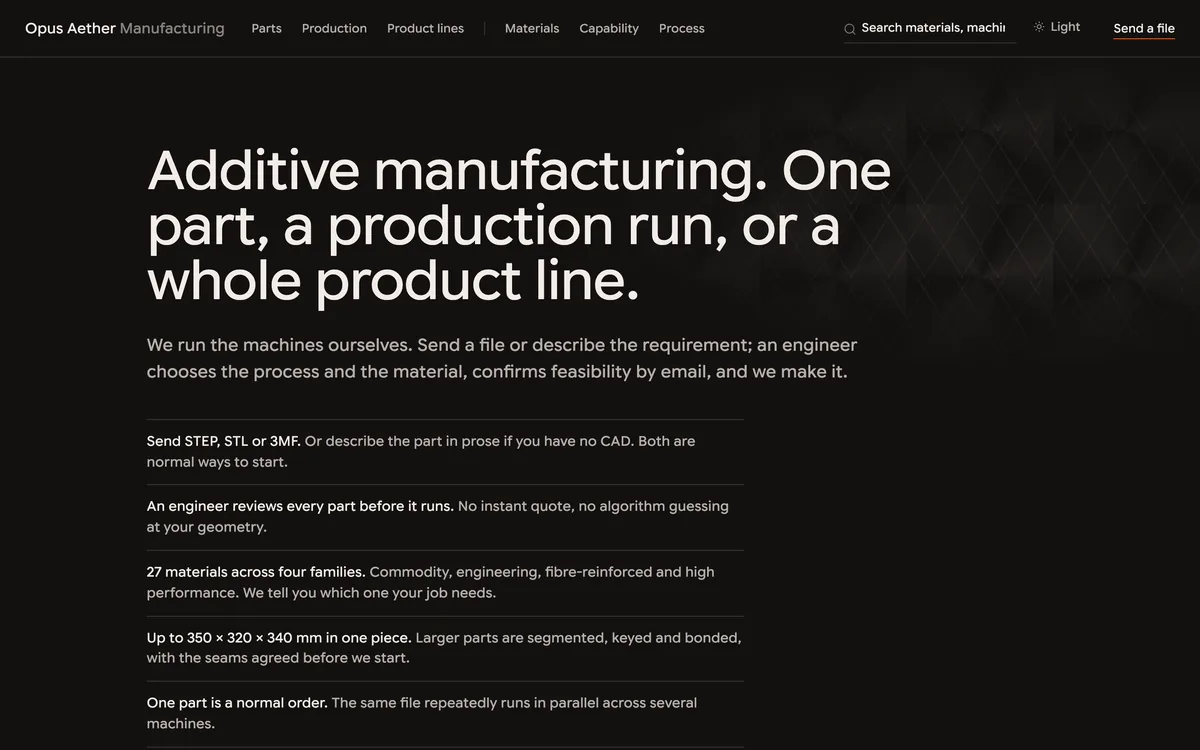
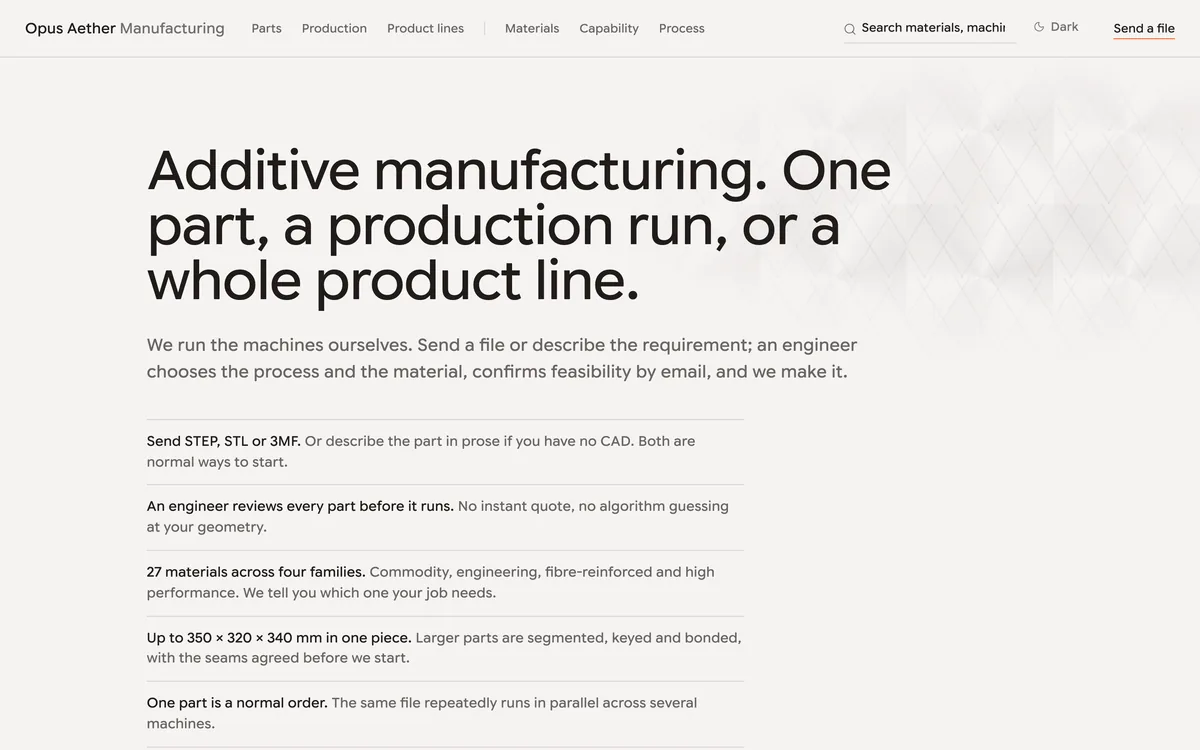
We run the machines ourselves. Send a file or describe the part, and an engineer confirms feasibility by email before anything prints.
How an order starts
Send STEP, STL or 3MF, or describe the part in prose if you have no CAD. Both are normal ways to begin and both enter the same review. One part is a normal order, and the same file can run in parallel across several machines when you need a batch.
A person reads every part before it runs
The geometry is analysed rather than eyeballed: mesh integrity is validated and slicer settings are derived from your actual geometry against the material, the nozzle and what the part has to survive. Then an engineer checks orientation and layer axis, wall and feature minimums, material fit to the service environment you described, and whether the part fits the envelope or needs segmenting.
You hear the problems before they cost you
The feasibility email says what we would make it from, what we would change and why, and anything we have flagged. If something in the geometry is going to cost you, you find out before it is printed rather than after. Parts larger than the envelope are segmented, keyed and bonded, with the seams agreed before we start.
The specifics
- Fleet
- H2D, H2S, X2D, A1 farm, Elegoo Saturn 4 Ultra 16K
- Max single part
- 350 × 320 × 340 mm
- Materials
- 27, across four families
- Nozzles
- 0.2 to 0.6 mm
- Layer height
- 0.06 to 0.4 mm
- Max nozzle temperature
- 350 °C
- Heated chamber
- 65 °C
- Files accepted
- STEP, STL, 3MF, OBJ, IGES, plus PDF or DXF drawings
Machine figures are manufacturer specifications for the machines named. They are not measured by us and are not a guarantee of part performance, which is assessed per part during review.
Want one of these for your company?